"*" indicates required fields
Why Choose Mild Steel Pipe for Global Projects? The answer begins with practical performance, not marketing language. Mild Steel Pipe offers a balanced combination of strength, weldability, availability, and cost control. These qualities matter when projects cross borders, climates, and supply chains.
A six-metre pipe section can be transported, lifted, aligned, and welded with familiar site equipment. Fabricators can cut it for water lines, structural supports, drainage systems, and general industrial service. Its relatively simple composition also supports predictable machining and joining practices. That familiarity reduces training demands, especially when local contractors use different equipment or methods. Small details matter.
However, mild steel is not automatically the best choice. Engineers must match wall thickness, diameter, pressure rating, temperature, and service environment. Unprotected pipe may corrode quickly near saltwater, humid storage yards, or chemically aggressive soil. Suitable coatings, linings, cathodic protection, or drainage design may be necessary. These decisions should follow project specifications and recognized standards, not habit.
Reliable procurement also requires more than comparing prices. Buyers should review mill certificates, heat numbers, dimensional reports, weld procedures, and inspection records. Independent testing can confirm chemical composition, tensile strength, impact performance, and coating quality when risk justifies the cost. A useful lesson from many projects is that early assumptions can fail at installation. Availability may change. Delivery routes may tighten. A technically sound pipe can still create delays without verified documentation and realistic logistics planning. Mild Steel Pipe remains valuable because it combines proven engineering practice with adaptable project planning, provided its limitations receive equal attention.
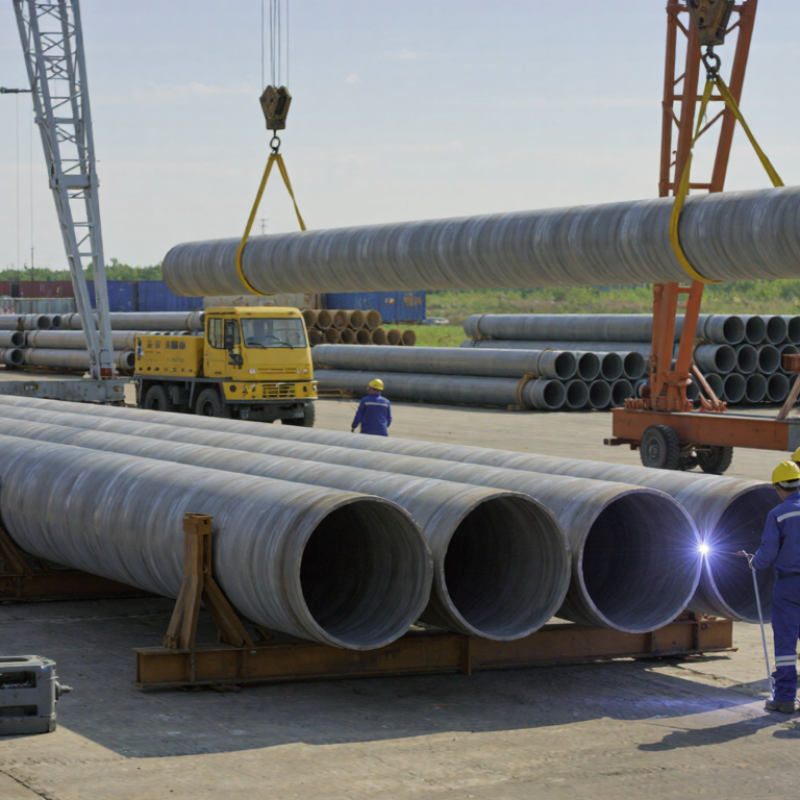
Why Choose Mild Steel Pipe for Global Projects?
What Is Mild Steel Pipe?
Mild steel pipe is manufactured from low-carbon steel, usually containing about 0.05% to 0.25% carbon. This range is not universal. Specifications can differ between standards and project regions. Its relatively low carbon content improves weldability, bending performance, and fabrication efficiency.
That matters on busy construction sites. Workers can cut, weld, and install mild steel pipe using widely available equipment. Common applications include water transmission, structural supports, compressed air, and industrial utility lines. Welded and seamless versions serve different pressure and reliability requirements. Standards still matter.
The World Steel Association reported approximately 1.89 billion tonnes of crude steel production in 2023 (World Steel in Figures 2024). This scale supports broad raw-material availability and established processing capacity. However, availability does not guarantee suitability. Engineers must check wall thickness, pressure, temperature, corrosion exposure, and connection methods.
Mild steel is not naturally corrosion-proof. Bare pipe may deteriorate quickly in humid soil or coastal air. Protective coatings, linings, drainage design, and inspection schedules are essential. The NACE IMPACT study estimated global corrosion costs at about 3.4% of worldwide gross domestic product. That figure is older, but the warning remains useful. A lower purchase price can become expensive when maintenance is ignored.
Mild steel pipe remains practical for water lines, structural supports, and industrial utility systems. Its carbon content is commonly below 0.25%, although limits vary by grade and standard. This lower carbon level supports easier cutting, forming, and welding on busy project sites. Welders can repair sections without highly specialized procedures. That matters where local fabrication capacity differs widely.
Strength is another useful property. Many common carbon-steel pipe grades provide yield strengths around 200–250 MPa, depending on specification and wall thickness. ASTM A53 and ISO 3183 demonstrate how testing requirements define pressure, dimensions, and mechanical performance. These standards reduce guesswork during international procurement. The World Steel Association reported approximately 1.89 billion tonnes of crude steel production in 2023. That large production base supports broad material availability and established logistics.
But mild steel is not automatically durable everywhere. Its exposed surface can rust quickly in humid, coastal, or chemically aggressive environments. Coatings, linings, drainage design, and inspection remain necessary. Designers should also check temperature, pressure, weld quality, and seismic loading. A thicker wall is not always the best answer. It may increase weight, transport cost, and installation effort. The overlooked weakness is often corrosion planning. Material selection should follow the project standard, not habit.
Why Choose Mild Steel Pipe for Global Projects?
Mild steel pipe supports global projects through practical strength, workable fabrication, and wide availability. In water lines, structural frames, and utility networks, engineers value its predictable performance. Its welding behavior helps local fabrication teams use familiar tools. Cut lengths, threaded ends, and welded joints can be prepared efficiently. This matters when labor, equipment, and schedules differ between countries.
A reliable specification should define diameter, wall thickness, grade, pressure class, and inspection requirements. Engineers often review mill certificates, chemical composition, tensile strength, and dimensional tolerance before dispatch. Visual checks can reveal dents, lamination, or damaged threads. Small defects become expensive later. For outdoor installations, painting, galvanizing, or another suitable coating can reduce corrosion. The correct choice depends on exposure, temperature, and maintenance access. Packing also matters. End caps and dry storage help prevent contamination during long transport.
Mild steel pipe is not perfect. It can corrode, and heavy sections increase lifting demands. That weakness deserves honest planning. Its broad availability may simplify replacement work in remote areas, but compatibility must be verified. Do not assume it. On one project, a small wall-thickness mismatch delayed a connection and required extra machining. It was a useful reminder: low purchase cost cannot replace quality control. Documented inspections, realistic delivery allowances, and clear coating plans help site teams install pipe safely and maintain it over time.
| Project Dimension | Relevant Mild Steel Pipe Data | How It Supports Global Projects | Typical Status or Reference |
|---|---|---|---|
| Material Composition | Low-carbon steel commonly contains approximately 0.05%–0.25% carbon by mass. The exact composition depends on the selected grade and specification. | Lower carbon content generally improves weldability and makes fabrication easier for pipelines, structural systems, and utility networks. | Grade-dependent |
| Mechanical Strength | Common structural and piping grades provide yield-strength levels that typically range from about 235 MPa to 355 MPa, depending on the applicable standard and grade. | Provides practical load-bearing performance for water lines, support structures, construction services, and industrial pipework. | Typical range |
| Manufacturing Options | Available as seamless or welded pipe. Welded pipe may be produced using longitudinal or helical welding processes. | Multiple production routes allow project engineers to balance diameter, wall thickness, pressure requirements, lead time, and cost. | Widely available |
| Standardization | Project specifications may reference standards such as ASTM, ASME, API, ISO, EN, or equivalent national standards. | Recognized technical standards help international teams define dimensions, tolerances, testing, inspection, and acceptance requirements. | Specification-based |
| Size Flexibility | Commercial pipe ranges cover small service sizes through large-diameter transmission and infrastructure applications. Outside diameters, wall thicknesses, and schedules vary by standard. | Supports diverse applications, including building services, irrigation, water transmission, piling, and process systems. | Broad range |
| Weldability | Low-carbon grades are generally suitable for common arc-welding methods when the correct welding procedure, consumable, and preheating requirements are applied. | Facilitates field joining, modification, repair, and integration with fittings or fabricated assemblies. | Procedure-controlled |
| Joining Methods | Typical joining methods include butt welding, flanged connections, threaded connections for smaller sizes, and mechanical couplings. | Gives contractors flexibility when site conditions, maintenance access, or local installation practices differ between regions. | Application-dependent |
| Corrosion Protection | Unprotected mild steel can corrode in the presence of water, oxygen, salts, or aggressive chemicals. Protection may include coatings, galvanizing, linings, cathodic protection, or corrosion allowance. | Protection systems can be selected according to soil conditions, water chemistry, temperature, exposure, and service life requirements. | Required when exposed |
| Temperature Capability | Service temperature limits depend on the steel grade, design code, pressure, toughness requirements, weld procedure, and operating environment. | Allows use across many normal-temperature infrastructure and industrial services when the design is checked against the applicable code. | Design-checked |
| Pressure-Service Suitability | Pressure capacity is determined by outside diameter, wall thickness, material strength, weld efficiency, corrosion allowance, temperature, and the governing design code. | Enables safe selection for water, air, gas, and process applications without relying on material name alone. | Engineering calculation required |
| Availability and Logistics | Mild steel pipe is produced in many regions and is commonly supplied in standard lengths, sizes, and wall thicknesses. | Broad market availability can simplify procurement, replacement planning, customs documentation, and local sourcing for international projects. | Generally favorable |
| Fabrication and Installation | Pipe can be cut, beveled, welded, drilled, coated, and assembled using widely used fabrication equipment and skills. | Reduces dependence on highly specialized equipment and supports construction teams with different levels of local capability. | Construction-friendly |
| Lifecycle Maintenance | Inspection may include visual examination, dimensional checks, coating assessment, ultrasonic testing, radiographic testing, or hydrostatic testing as required. | Established inspection and repair practices help asset owners maintain water, utility, structural, and industrial systems over time. | Established practice |
| Recyclability | Steel products can be recovered and recycled through established metal-recycling processes at the end of their service life. | Supports material recovery objectives and can contribute to resource-efficiency targets when collection and recycling infrastructure is available. | Recyclable material |
| Common Global Applications | Typical uses include water transmission, drainage, irrigation, piling, fire-protection systems, structural supports, compressed-air lines, and general industrial services. | One material family can support infrastructure, construction, utilities, agriculture, and industrial projects across different markets. | Multi-sector use |
Mild steel pipe remains practical for global infrastructure because it combines strength, weldability, and manageable cost. Its reliability depends on disciplined manufacturing, not appearance alone. Project teams should define the required standard, grade, outside diameter, wall thickness, and end finish before production begins. Common specifications may include ASTM, API, EN, or project-specific requirements. The selected standard must match the service conditions.
Quality control should cover chemical composition, tensile strength, yield strength, elongation, dimensional tolerance, and surface condition. Hydrostatic testing can reveal leakage risks, while ultrasonic or radiographic inspection may detect hidden flaws. Each pipe should carry clear heat numbers and inspection records. Traceability matters when thousands of sections reach different construction sites. A certificate alone is not proof. Records must match the physical markings.
Tips: Check the latest applicable standard. Confirm test methods, acceptance limits, coating needs, and documentation requirements. Inspect random bundles on arrival, including wall thickness and end squareness. Small measurement errors can create large fitting problems.
Experienced inspectors still miss details sometimes. Moisture, rough handling, or poor storage can damage otherwise compliant pipe. That is why inspection should continue after shipment, not end at the factory gate.
Why Choose Mild Steel Pipe for Global Projects?
Factors for Selecting Mild Steel Pipe Internationally
Mild steel pipe remains practical for water lines, structural supports, and general industrial systems. Its balanced strength and workable fabrication suit many project conditions. International selection, however, demands more than comparing prices. Engineers should review pressure, temperature, soil conditions, transport distance, and installation methods before approving a specification.
Material grade matters. Confirm the required yield strength, wall thickness, dimensions, and chemical composition through reliable mill certificates. Relevant international standards should match the project’s design code and local inspection rules. Weldability also deserves attention, especially when field crews work with limited equipment. Poorly matched grades can cause cracking, delays, or expensive repairs.
Corrosion protection is another major factor. Bare pipe may perform poorly in coastal air, wet soil, or chemically aggressive service. Coatings, linings, cathodic protection, and suitable drainage can extend service life. Logistics should include pipe length, weight, packing, port handling, and customs documentation. Traceable markings help inspectors verify each batch after delivery. They also reduce confusion during site storage.
A lower purchase price can mislead.
Project teams sometimes overlook local welding skills or replacement access. That decision may appear efficient, but it can increase lifecycle costs. Mild steel pipe is not automatically the best option for every fluid or climate. A careful review of service conditions, documentation, and maintenance capacity creates a more dependable choice, even when the final specification needs revision.
Minimum specified mechanical properties of commonly used carbon steel pipe grades in international projects.
Mild steel pipe is widely selected because it combines practical strength, weldability, established international standards, and broad availability. The values shown are minimum specified properties for the listed grades; actual requirements can vary by wall thickness, manufacturing method, and project specification.
Reference standards: ASTM A53 Grade B, ASTM A106 Grade B, API Specification 5L Grade B, and EN 10217-1 Grade P235TR1.
"*" indicates required fields