"*" indicates required fields
A Trackless Transfer Cart moves materials across a factory or warehouse floor without fixed rails. It typically runs on wheels and uses an electric drive, with an operator or control system directing its route. Some models follow magnetic markers, QR codes, or laser guidance; others are manually steered. The exact setup depends on the facility and the task.
The term describes a broad family of equipment, not one standard design. Common types include flat-deck carts for pallets, V-deck carts for coils, and lift-table carts for adjusting load height. Heavy-duty models carry large components, while compact carts suit narrower work areas. Power and control options create another useful distinction, such as battery-powered, cable-powered, manual, or automated units. These categories can overlap. That matters.
Choosing a cart involves more than matching its rated capacity to the load. Buyers also need to consider load dimensions, floor condition, turning space, travel distance, and how materials are loaded or unloaded. A cart rated for a particular weight may still be unsuitable if the load is uneven or difficult to secure. It is worth checking those details against the actual route, not just a specification sheet. This guide explains how trackless carts work, compares their main types, and outlines the practical factors that shape a suitable choice. Some distinctions are less tidy than product labels suggest. That is worth remembering.
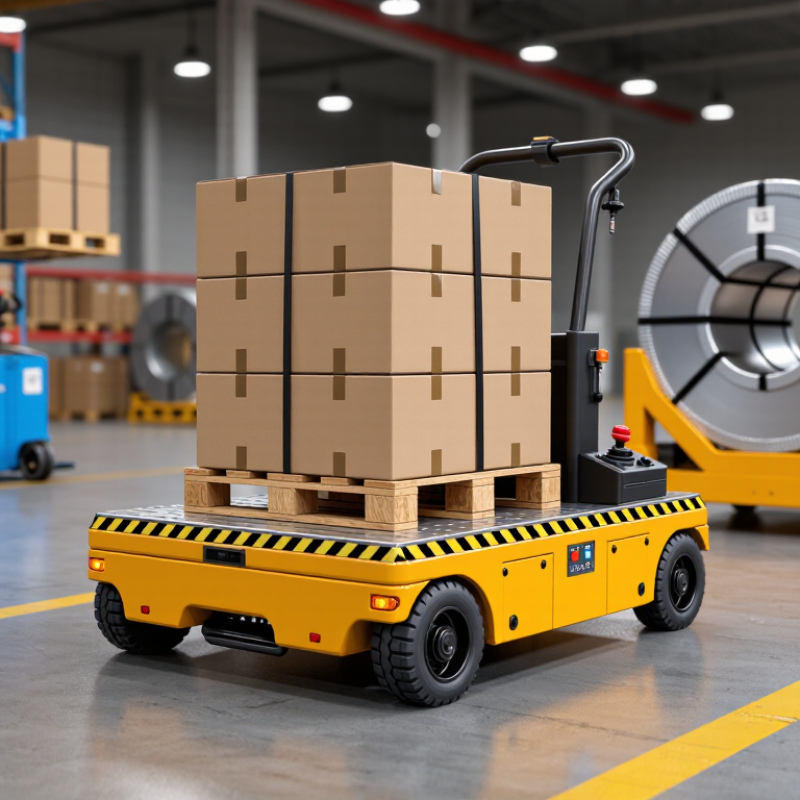
A trackless transfer cart is a powered, wheeled platform that carries materials across a factory or warehouse without fixed rails. It may follow an operator, a programmed route, or navigation cues such as floor markers and laser-based maps. Loads sit on a flat deck, rollers, or a lifting surface. Think of a steel pallet moving from a machining cell to a packing area. Quietly, but not magically.
The International Federation of Robotics reported nearly 86,000 professional service robots sold for transportation and logistics in 2022, up 44% from 2021, in its World Robotics 2023 report. This figure covers a wider category of mobile robots, not trackless carts alone, but it shows the growing role of automated material movement. In practice, cart selection depends on payload, route width, floor condition, and how people share the travel path. A small floor crack can matter when a loaded cart crosses it repeatedly. The part that deserves more thought is the workflow: a cart can move reliably, yet still create delays if pickup points or traffic rules are unclear.
A trackless transfer cart moves loads on wheels rather than fixed rails. No rails are needed. Its drive motors turn the wheels, while a controller regulates speed, steering, and stopping. Depending on the model, operators may steer it with a handheld control, or it may follow a programmed route using laser scanners, cameras, magnetic markers, or mapped features. Sensors can detect obstacles and trigger a stop or route adjustment. That sounds simple. In practice, floor joints, tight turns, changing loads, and busy crossings all affect reliable movement.
During operation, the cart receives a task, travels to a pickup point, and carries its load to a designated destination. The load may sit on a flat deck, roller surface, or lifting platform. The International Federation of Robotics’ World Robotics 2024 report recorded 541,302 industrial robots installed worldwide in 2023; this is broader automation context, not a count of transfer carts. For a cart installation, teams should check load weight, turning clearance, stopping distance, floor condition, and pedestrian routes. ISO 3691-4:2023 covers safety requirements for driverless industrial trucks and their systems. A digital route map is not enough. Real-world trials matter, and site conditions can expose gaps that a tidy layout misses.
Trackless transfer carts move loads across factory floors without fixed rails. Their main types differ by deck, steering system, and guidance method. Flatbed carts carry pallets, steel plates, or machine parts. Low-profile models slide beneath racks or fixtures. Heavy-duty platforms handle bulky dies and coils, but need careful floor-load checks.
Guidance creates another useful distinction. Some carts follow magnetic tape or embedded markers; others use laser or vision navigation to avoid obstacles and adjust routes. Omnidirectional models can move sideways in tight assembly spaces, though their controls and maintenance are more demanding.
The International Federation of Robotics reported 113,000 transportation and logistics robots sold in 2023, up 35% from 2022, in World Robotics 2024. This is a broad robot category, not a trackless-cart sales figure, but it shows rising automation interest.
In practice, route width, turning space, payload, and floor condition matter more than a feature list.
Tips: Match cart type to the actual load and route. Keep routes clear. Test it loaded. A small trial can reveal awkward turns or stopping issues before fleet-wide use. I would still recheck the layout after production changes; even a well-chosen cart can struggle when staging areas drift.
A trackless transfer cart moves heavy loads across a factory floor without fixed rails. Its core components typically include a welded frame, drive wheels, electric motors, a controller, and an onboard battery. Sensors and emergency-stop buttons help detect obstacles and stop the cart. Some models also use bumpers, warning lights, and load-positioning fixtures. The exact setup depends on load weight, floor condition, travel distance, and operating shifts.
Power options include rechargeable batteries, cable reels, and contactless charging systems. Battery carts offer flexible routes, but charging time and battery replacement need planning. Cable reels can suit repeated routes, though trailing cables may complicate traffic. Contactless charging can reduce manual charging stops, but requires compatible infrastructure. The International Federation of Robotics reported about 86,000 professional transport and logistics robots sold in 2022, across the wider category—not transfer carts alone. This growth reflects rising interest in automated material movement, but does not make every facility a good fit. Small details matter.
Tips: Check the cart’s rated load, turning radius, braking distance, and floor slope using real operating conditions. A smooth test route can be misleading. Track actual duty cycles before choosing battery capacity; estimates often miss waiting time and extra trips. Could the charging point interrupt production? Consider that early.
| Category | Type or Component | Description and Typical Use | Key Details |
|---|---|---|---|
| Cart types | General-purpose flat-deck cart | Moves pallets, fabricated parts, equipment, and other unit loads between workstations or buildings. | Usually has a low, flat platform; load restraints or locating features can be added to suit the cargo. |
| Heavy-duty transfer cart | Handles large, concentrated, or unusually heavy loads in industrial production and material-handling areas. | Capacity is determined by the frame, wheel arrangement, floor condition, load distribution, and operating duty. | |
| Coil or roll-handling cart | Transports steel coils, paper rolls, cable reels, or similar cylindrical loads. | May use a V-shaped cradle, saddles, or other shaped supports to help prevent the load from rolling. | |
| Mold or die cart | Moves heavy molds, dies, and tooling between storage, maintenance, and production equipment. | May include locating blocks, powered rollers, or a lifting surface to align the load with a machine. | |
| Lift-table transfer cart | Raises or lowers a load to assist with workstation access, loading, or height matching. | Typically uses hydraulic or electromechanical lifting equipment; rated capacity applies to specified conditions. | |
| Omnidirectional cart | Moves forward, backward, sideways, or diagonally where floor space is limited. | Uses a suitable multi-directional wheel or drive arrangement; maneuverability depends on the floor and load. | |
| Main components | Structural frame and deck | Supports the payload and provides the mounting structure for the cart’s equipment. | Designed for the intended load, load distribution, impact conditions, and operating environment. |
| Wheels, axles, and bearings | Carry the cart and transfer loads to the floor. | Wheel material and size affect floor compatibility, rolling resistance, and load capacity. | |
| Drive motors and transmission | Provide powered movement through geared motors, drive wheels, and related mechanical parts. | Configuration varies with payload, speed, gradients, turning requirements, and duty cycle. | |
| Steering system | Controls the cart’s direction of travel. | May use mechanical, electric, differential, or multi-directional steering, depending on the design. | |
| Controls and operator interface | Allow an operator or automated control system to command movement and operating functions. | Can include a pendant, onboard controls, wireless remote, or interfaces for a facility control system. | |
| Braking and safety devices | Help stop the cart and reduce risks to people, equipment, and loads. | May include service and holding brakes, emergency stops, warning lights or sounders, and obstacle detection. | |
| Load restraints and positioning features | Help keep the payload stable and correctly located during travel. | Examples include stops, clamps, cradles, locating pins, and powered transfer mechanisms. | |
| Power options | Battery-electric power | Supplies energy from onboard batteries and is commonly used for indoor, trackless operation. | Battery chemistry, capacity, charging method, runtime, and recharge time depend on the application. |
| Lead-acid battery | A rechargeable battery option used in industrial equipment. | Typically requires planned charging and appropriate ventilation and maintenance procedures. | |
| Lithium-ion battery | A rechargeable option that can support opportunity charging in appropriately designed systems. | Requires a compatible battery-management system, charger, and operating protections. | |
| Cable-reel or cable-fed power | Provides power through a cable connected to a stationary supply as the cart moves. | Can reduce reliance on onboard battery energy, but cable routing and travel distance must be managed. | |
| Engine-driven power | May be selected for certain outdoor or site-specific applications where the operating environment permits it. | Fuel, exhaust, noise, ventilation, and applicable safety rules should be considered before selection. | |
| Selection note | Application-specific design | “Trackless” means the cart does not depend on a fixed rail track for its route. Capacity, speed, turning behavior, runtime, and safety features vary by design; confirm them against the load, floor, route, and operating conditions. | |
Choosing a trackless transfer cart starts with the load, not the catalog photo. Record the heaviest load, including pallets, fixtures, and any uneven weight distribution. Then measure the narrowest aisle, door opening, and turning space. A cart that fits the load may still struggle to turn beside a machine. Measure twice.
Check the floor, too. Dust, oil, joints, and slight slopes can affect wheel grip and stopping distance. Match the drive system and battery capacity to the route length, travel frequency, and charging time available between shifts. For frequent trips, confirm the cart can handle repeated starts without overheating. Small details matter. A control handle positioned awkwardly can slow operators, even when the cart’s rated capacity looks right.
Ask how the cart will interact with people and equipment. Visibility, warning signals, emergency stops, and obstacle detection should suit the site’s traffic and sightlines. Test the proposed turning path with a marked outline or a trial run; drawings often miss real-world obstructions. I would not choose by maximum capacity alone. Extra capacity can mean a larger turning radius, and that trade-off is easy to underestimate. Check maintenance access and replacement-part availability before specifying the cart.
"*" indicates required fields