Top 10 Reaction Injection Molding Companies for Buyers

Choosing a Reaction Injection Molding partner involves more than comparing company names. Buyers need to match a supplier’s capabilities to the part, production volume, and project timeline. A housing with thin walls may demand different tooling and process controls than a large, flexible enclosure. Small details matter. Ask about material options, mold design, prototype support, and expected production quantities. Request examples of comparable parts, not just polished product photos.

This Top 10 guide offers a practical starting point for evaluating potential suppliers. It considers factors such as engineering support, manufacturing capacity, quality practices, communication, and services like trimming or assembly. A ranked list cannot predict how well a company will handle your specific project. Published capabilities may also change, so confirm current equipment, lead times, and quality documentation directly. Be cautious with vague promises. Share drawings, performance requirements, and realistic volume estimates when requesting a quote; clearer inputs make supplier responses easier to compare. If a critical tolerance or surface finish is still undecided, say so. That uncertainty may affect pricing and schedule. No supplier profile tells the whole story. Use these companies to build a shortlist, then verify the fit through technical discussions and a clearly scoped proposal.
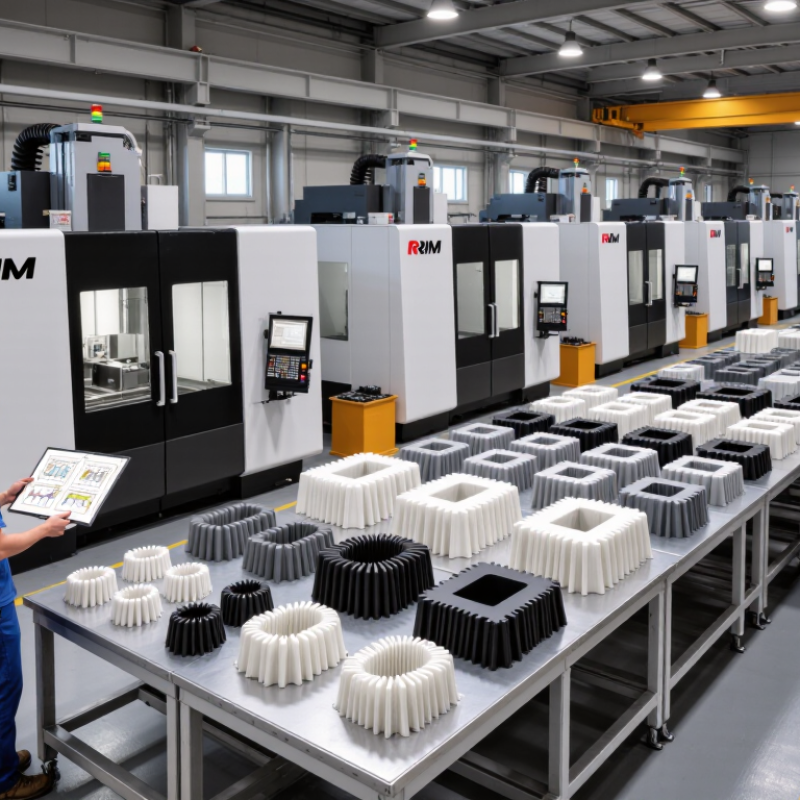
Top 10 Reaction Injection Molding Companies for Buyers

Understanding Reaction Injection Molding and Its Applications

Reaction injection molding (RIM) mixes two liquid, reactive components and injects them into a closed mold. The material cures inside the tool, forming a solid part. Unlike conventional injection molding, RIM typically uses lower pressures and can produce large, lightweight components with relatively thin walls. Think of a broad automotive fascia or an equipment cover with ribs molded into its underside. The process suits complex shapes, but cure time and mold design still affect production speed and consistency.

Applications include vehicle body panels, medical equipment housings, appliance parts, and industrial enclosures. Grand View Research’s 2022 market report estimated the global RIM market at about US$1.2 billion that year, with projected annual growth of 8.1% from 2023 to 2030. These are forecasts, not guarantees. Material choice matters: polyurethane systems can offer useful impact resistance, while surface finish and dimensional stability depend on the formulation and process controls. A lightweight part can still disappoint if its mounting points flex too much.

Tips: Ask suppliers for sample parts made with your intended wall thickness and geometry. Check finish, fit, and strength at actual attachment points. Also clarify tooling costs and expected cycle times. A polished sample tells only part of the story. Test under real use conditions before committing to production.

How to Evaluate Reaction Injection Molding Companies

When evaluating Reaction Injection Molding Companies, look beyond a polished sample. Ask how they control resin temperature, mix ratio, mold temperature, and cure time. These settings affect surface finish, part weight, and dimensional stability. Request inspection records from repeat production runs, not only prototype results. Ask to see evidence.

Check whether the company can explain its process limits in practical terms: minimum wall thickness, achievable tolerances, and expected cycle time. Confirm who designs and maintains the tooling, and how changes are documented. A capable supplier should discuss likely defects, such as voids or incomplete filling, and show how operators detect them. Numbers matter. If answers stay vague, request a sample inspection report and a realistic production quote.

Market context can help frame the discussion, but it is not a supplier scorecard. Grand View Research estimated the global polyurethane market at USD 78.1 billion in 2022 and projected 5.8% annual growth from 2023 to 2030. That broad material-market figure does not measure reaction injection molding capacity. Use it only as context. Compare suppliers on relevant evidence: equipment range, material expertise, quality records, and response to design changes. I would still treat one flawless part cautiously; a single sample proves little about consistency across a full run.

Profiles of 10 Reaction Injection Molding Companies

The ten profiles examine different strengths among reaction injection molding suppliers, without treating every shop as interchangeable. Some focus on large, lightweight panels; others handle equipment housings, prototypes, or integrated finishing. Buyers should look for evidence of experience with the intended resin, part size, and annual volume. Ask how the supplier controls mix ratio, mold temperature, and cure time. These details can affect surface quality and dimensional consistency. Small process variations matter.

The wider plastics market offers useful context, but not a direct measure of RIM demand. Plastics Europe’s Plastics—The Facts 2023 report estimates global plastics production at 400.3 million metric tonnes in 2022. RIM represents only one part of that broad industry. The report does not isolate RIM output, so treating the figure as a market-size estimate would be misleading. That distinction matters.

The profiles compare practical buyer questions: Does the supplier support design-for-manufacture reviews? Can it make a textured panel with stable wall thickness? Are tooling, trimming, and inspection handled in-house? Look for clear process documentation and sample-part evidence, not just equipment lists. A polished brochure is easy. Repeatable parts are harder. Supplier comparisons can still miss a key issue: a capable prototype partner may not have the capacity or controls needed for steady production.

Comparing Company Capabilities, Materials, and Services

Buyers comparing reaction injection molding companies should look beyond quoted part prices. Ask how each supplier controls mix ratio, mold temperature, and cure time. These details affect cell structure, surface quality, and repeatability. Request sample parts that resemble your design, not just polished showroom pieces. A capability sheet can look reassuring, yet leave out useful process limits.

Material selection depends on the part’s job. Flexible polyurethane may suit protective covers, while rigid grades can support larger housings. Confirm that the supplier can explain density, hardness, flame performance, and aging behavior for the proposed grade. Also compare services: design-for-manufacturing reviews, prototype tooling, production tooling, trimming, and inspection. Ask what inspection records come with each run. I would not assume every listed service is performed in-house; that detail can change lead times and accountability. It is easy to overlook.

Tips: Send the same drawing and annual-volume estimate to each candidate. Ask for a short trial plan, including acceptance checks for dimensions, skin quality, and weight. Clarify who handles tool changes and how process adjustments are documented. A small trial may reveal more than a long sales presentation.

Choosing a Supplier for Your Project Needs

Choosing a reaction injection molding supplier starts with the part, not the sales pitch. Share a clear drawing, expected annual volume, resin requirements, and operating conditions. A supplier should ask about wall thickness, draft angles, inserts, and undercuts before quoting. Those details affect tooling, cycle time, and the risk of defects. If questions are missing, clarify the scope before comparing prices.

Review how each candidate handles process control. Ask how they monitor mix ratio, mold temperature, cure time, and part dimensions. Request a sample inspection report and learn how changes to materials or tooling are documented. A low quote may exclude fixtures, finishing, or inspection steps. Check lead times against your launch schedule, and confirm what happens if a trial part fails. Small details count.

Look for relevant experience with similar part sizes and performance needs, rather than a broad claim of expertise. Discuss the actual tolerance range your design requires; tighter tolerances can add cost without improving function. A visit or technical call may reveal how clearly the team explains risks. No supplier is perfect, and I would not treat a polished capability sheet as proof. Compare evidence, communication, and willingness to flag design trade-offs before making a choice.

Top 10 Reaction Injection Molding Companies for Buyers - Choosing a Supplier for Your Project Needs

Buyer comparison framework—not a ranked company directory. Use these criteria to compare suppliers against your project requirements.

No. Supplier Evaluation Dimension What to Verify Project Fit / Buyer Consideration
1 Material and chemistry expertise Confirm experience with the required polyurethane system, such as rigid, flexible, or elastomeric formulations. RIM commonly mixes reactive liquid components in a metering-and-mixing system before injecting them into a mold. Ask for material data sheets and test results tied to the intended operating temperature, chemical exposure, and mechanical requirements.
2 Part size and geometry capability Check the supplier’s demonstrated mold, machine, and handling capacity for the part’s dimensions, projected area, wall sections, and geometry. RIM can be considered for large or complex molded parts, but achievable dimensions and design limits are equipment- and tool-specific.
3 Design-for-manufacturing support Ask whether the supplier reviews draft, wall transitions, ribs, bosses, parting lines, and venting before tooling begins. Early design review can help identify filling, demolding, and cosmetic risks before committing to production tooling.
4 Tooling approach and ownership Clarify proposed tool construction, expected maintenance, repair responsibility, lead time, and ownership terms. RIM tooling materials and construction vary by application and production needs. Compare the full tooling plan and lifecycle costs, not only the initial tool quote.
5 Inserts and secondary operations Verify capability for insert placement, trimming, drilling, bonding, assembly, and other specified post-molding steps. Request process details for insert location control and confirmation that all secondary operations are included in the quotation.
6 Dimensional control and inspection Request a proposed inspection plan, measurement method, sampling frequency, and capability evidence for critical characteristics. Set tolerances with the supplier during design review; achievable tolerances depend on part geometry, material, tooling, and process conditions.
7 Quality system and traceability Review the supplier’s quality procedures, nonconformance handling, material lot records, and ability to provide documentation required by your industry. Specify required certifications and records in the request for quotation; verify current certificates directly with the supplier.
8 Production volume and scalability Discuss expected annual demand, order size, capacity allocation, changeover requirements, and plans for demand fluctuations. Ask for separate quotations or assumptions for prototypes, initial production, and forecast volumes rather than assuming one cost structure fits all stages.
9 Surface finish and finishing options Confirm available as-molded finishes and any painting, coating, texture, or cosmetic inspection services relevant to the part. Define appearance requirements with samples, drawings, or agreed acceptance standards before production approval.
10 Lead time, logistics, and total cost Compare quoted timing for design review, tooling, sampling, approval, and production, along with packaging, freight, and delivery terms. Evaluate total landed cost and schedule assumptions, including the time needed for tool trials, sample revisions, and customer approval.

"*" indicates required fields