China Top 10 Inverter Voltage Stabilizer Suppliers?
China has become a major sourcing base for voltage regulation equipment, including the Inverter Voltage Stabilizer. Manufacturers serve residential, commercial, industrial, and renewable energy applications. Their product ranges often include single-phase and three-phase models, automatic voltage regulators, and systems designed for unstable grids.
Choosing among China’s top suppliers requires more than comparing catalog prices. Buyers should examine rated capacity, input-voltage range, output accuracy, response time, cooling design, protection functions, and verified operating conditions. A workshop may need a rugged cabinet for dust and heat. A home installation may prioritize quiet operation and compact dimensions. Certification documents, factory testing records, warranty terms, and after-sales response also deserve careful review. Real projects reveal details that brochures sometimes miss.
Not every highly visible supplier is the best fit. That matters. Supplier rankings can change with production quality, export experience, and technical support. Some companies communicate well before an order but respond slowly after installation. This possibility should not be ignored. Independent inspections, sample testing, and reference checks can reduce uncertainty. Buyers should also confirm compatibility with sensitive loads, solar inverters, motors, and local electrical standards. The following overview introduces ten notable Chinese suppliers and explains the strengths buyers may investigate. It does not replace technical verification. Actual performance depends on installation, load behavior, maintenance, and grid conditions. A careful selection process may cost more initially, but it can prevent overheating, nuisance shutdowns, unstable output, and expensive equipment damage later. Real evidence matters most.
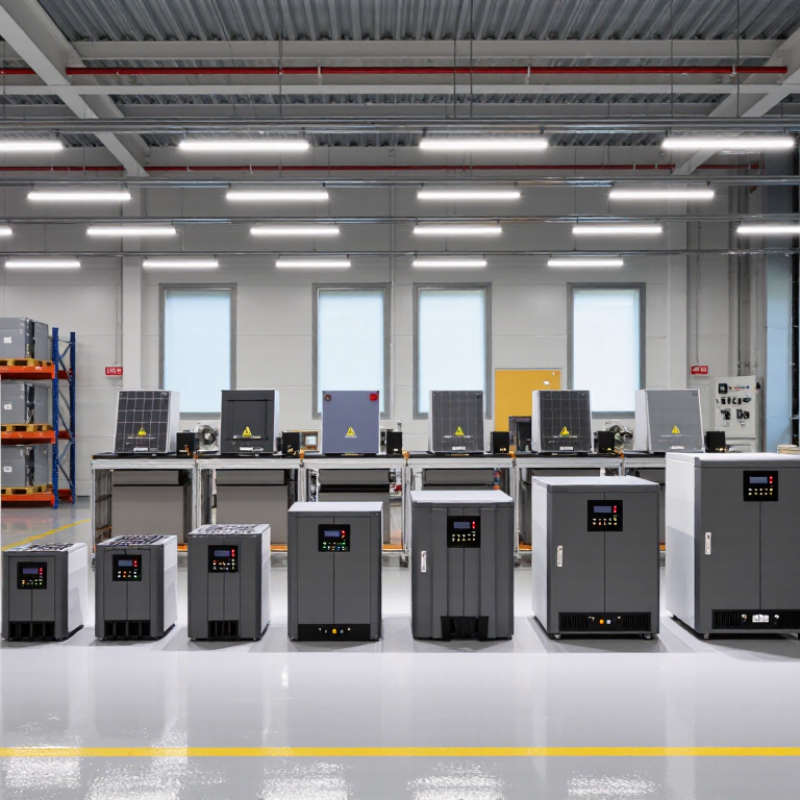
What Is an Inverter Voltage Stabilizer?
An inverter voltage stabilizer is an electrical device that keeps output voltage within a safer range. It monitors incoming power continuously. When voltage falls or rises, its electronic circuit adjusts the output quickly. Many designs convert AC power into DC, then recreate a controlled AC waveform through an inverter stage. This process can reduce flicker and protect sensitive equipment from unstable supply.
In practical installations, technicians check voltage with a calibrated multimeter before selecting a stabilizer. They also measure the equipment’s starting current, not only its printed running wattage. A refrigerator, pump, or server may demand much more power briefly. The stabilizer must handle that surge without overheating. Ventilation matters too. Dusty cabinets and blocked air openings can shorten service life.
An inverter stabilizer is not a complete answer to every power problem. It may not correct poor wiring, severe frequency changes, or an undersized electrical circuit. That distinction is often overlooked. I have also seen users choose capacity by appliance count alone, which can produce disappointing results. Professional installation should include grounding, protective breakers, bypass planning, and a realistic load test. Specifications deserve careful reading, because response time, efficiency, waveform quality, and allowable input range vary between models. Small differences become important when medical, communication, or precision-control equipment depends on stable electricity.
What Is an Inverter Voltage Stabilizer?
An inverter voltage stabilizer converts unstable electrical input into a controlled AC output. The chart below shows the ideal mathematical waveform for a 230 V RMS, 50 Hz inverter output. Its peak voltage is approximately 325 V, calculated as RMS voltage × √2.
Reference values: 230 V RMS, 50 Hz frequency, 20 ms cycle duration, and approximately ±325 V peak voltage.
How to Evaluate China’s Leading Suppliers
China Top 10 Inverter Voltage Stabilizer Suppliers: How to Evaluate China’s Leading Suppliers
China’s leading suppliers should be judged by evidence, not catalog size. The IEA’s Electricity 2024 report forecasts global electricity demand growth of about 4% in 2024 and 2025. This rising demand increases pressure on stabilizer suppliers to prove capacity, efficiency, and after-sales support. Ask for factory test records, production capacity, component traceability, and recent export references. A polished factory tour is not proof.
Technical performance deserves closer attention. Compare response time, voltage regulation accuracy, overload protection, thermal performance, and standby losses under realistic loads. IEC 61000-4-30 provides recognized methods for measuring power-quality parameters, while IEC 60038 defines standard supply voltages.
Suppliers should explain how their test equipment follows relevant standards. Request test results at low input voltage, unstable frequency, and partial load.
Real conditions matter.
Check certification validity independently. Verify serial numbers, laboratory scope, and certificate dates. ISO 9001 may indicate process control, but it does not guarantee product performance. The U.S. Energy Information Administration continues reporting substantial power interruptions across many markets, making service response and spare-parts availability commercially important.
Ask how quickly technical teams respond and whether replacement boards remain available for several years. I may still miss hidden weaknesses during a short audit. That is the uncomfortable part. Pilot testing is wiser than trusting promises.
China’s Top 10 Inverter Voltage Stabilizer Suppliers
China’s Top 10 Inverter Voltage Stabilizer Suppliers should be judged by tested performance, not factory size alone. The China Electricity Council reported continued growth in electricity consumption and grid investment in recent years. Meanwhile, the International Energy Agency expects China to drive about 60% of global electricity-demand growth through 2026. This creates demand for stable power in factories, data rooms, hospitals, and solar installations.
A reliable top-ten shortlist should examine voltage regulation speed, output waveform, overload protection, thermal design, and after-sales support. IEC 62040-3 provides useful performance guidance for power-conditioning equipment, while IEC 61000 standards help assess electromagnetic compatibility. Suppliers with ISO 9001 systems, routine load testing, and traceable component records deserve stronger consideration. Field experience matters too. A unit may pass a laboratory test but fail beside a dusty production line.
The ranking is not perfectly fixed. Buyer requirements change it. One supplier may excel at three-phase industrial systems, while another suits compact commercial units. Check efficiency at partial load, bypass behavior, noise levels, and spare-part availability. The U.S. Department of Energy identifies energy efficiency as a major factor in reducing operating costs, yet efficiency figures are sometimes presented without test conditions. That deserves careful review. Request independent test reports, installation references, and a clear warranty before selecting among China’s top 10 inverter voltage stabilizer suppliers.
Key Products, Technologies, and Applications
China’s top ten inverter voltage stabilizer suppliers should be assessed through products, technologies, and real applications, not advertising claims. The IEA’s Renewables 2024 report recorded almost 510 GW of global renewable capacity additions in 2023. Solar PV represented about three-quarters of that growth, increasing demand for stable power conversion and voltage control.
Chinese manufacturers commonly offer servo stabilizers, static stabilizers, online UPS systems, hybrid inverter units, and isolation transformers. Key technologies include IGBT switching, microprocessor monitoring, automatic bypass, surge protection, and buck-boost voltage correction.
For factories, these systems protect CNC equipment, robotic lines, and sensitive sensors. Hospitals and data rooms require faster response, low output distortion, and dependable battery support. Solar installations also need compatibility with fluctuating grid voltage and reverse power flow.
Technical judgment matters. IEC 61000-4-30 defines power-quality measurement methods, while IEC 62040-3 supports UPS performance classification. Ask suppliers for response-time curves, efficiency at partial load, overload duration, thermal limits, and independent test reports. A brochure is not proof. The China Energy Storage Alliance reported strong growth in China’s energy-storage market, yet installation quality can vary between projects. That point deserves more attention. A supplier may offer advanced controls but weak after-sales testing.
Tips: Compare measured output voltage, not only rated capacity. Request a factory acceptance test with realistic loads. Check spare-part availability, firmware support, and protection coordination. For humid workshops, inspect enclosure ratings and cooling design. A careful shortlist can still miss hidden maintenance costs.
