"*" indicates required fields

China has become a major sourcing center for composite molding equipment, especially for automotive, electrical, and household applications. This guide introduces ten notable suppliers of Bmc Composite Hydraulic Press systems for international buyers. The selection considers manufacturing experience, press capacity, automation options, export support, and after-sales service.
A reliable supplier should explain more than the machine’s nominal tonnage. Buyers need details about platen size, heating control, mold compatibility, cycle time, and energy consumption. A factory visit can reveal practical details, such as machining accuracy, assembly discipline, and spare-parts storage. Trial molding is also valuable. It shows whether the press can produce stable parts under real BMC conditions.
Not every supplier fits every project.
Some companies excel at standard presses, while others develop customized production lines. Certification documents, inspection records, and customer references should be checked independently. Public information is sometimes incomplete, and supplier rankings can change as factories expand or service quality declines. That limitation deserves attention. This list should therefore serve as a research starting point, not a final purchasing decision.
The comparison will focus on technical capability, communication quality, delivery reliability, and lifecycle support. It will also consider whether suppliers provide installation guidance, operator training, troubleshooting assistance, and clear warranty terms. These factors often matter after commissioning, when a small temperature error can affect surface quality or dimensional consistency. Careful evaluation helps buyers identify a capable Chinese partner and avoid choosing equipment based only on price.
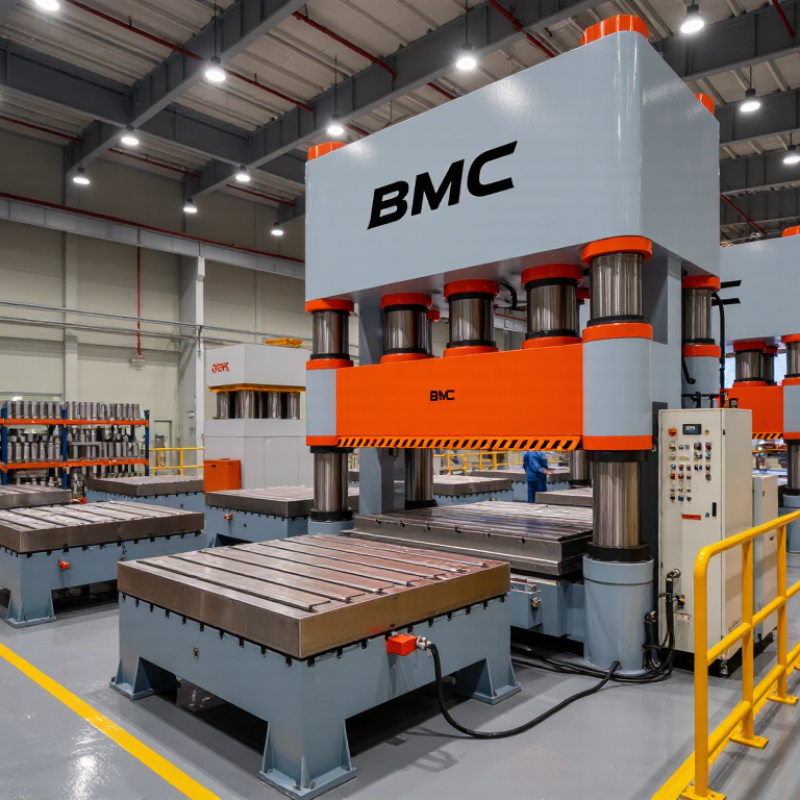
A BMC composite hydraulic press is industrial equipment used to shape Bulk Molding Compound into strong, heat-resistant components. BMC combines thermoset resin, chopped glass fibers, mineral fillers, pigments, and curing agents. The compound resembles a dense, dough-like material before molding.
During production, operators place a measured charge into a heated mold. Hydraulic cylinders then apply controlled pressure while the mold cures the material. Heat activates the resin, and the fibers improve stiffness and dimensional stability. Finished parts may include electrical housings, automotive covers, appliance components, and industrial enclosures.
A reliable press requires accurate platen alignment and stable pressure control. Even heating matters because cold areas can cause incomplete curing or visible surface defects. Adjustable stroke settings also help prevent excess flash around the mold. In supplier evaluations, buyers should examine machine testing records, mold compatibility, safety controls, and after-sales technical support. Practical experience shows that the first process setting is rarely perfect. Small changes in charge weight, temperature, or curing time can affect the final part. Operators should record each trial carefully and question results that appear acceptable too quickly. For China’s top ten BMC composite hydraulic press suppliers, these measurable details matter more than impressive specifications alone.
An anonymized capability comparison of common Chinese BMC composite hydraulic press supplier profiles. The specifications below represent practical industry ranges for BMC compression-molding equipment and are intended for preliminary supplier screening rather than company-specific certification.
| Rank | Supplier Profile | Typical Press Capacity | Typical Platen Size | Recommended BMC Applications | Machine Structure | Control and Automation | Key Buying Strength | Important Verification Point |
|---|---|---|---|---|---|---|---|---|
| 1 | Profile A | 1,000–3,000 tonnes | 1,200 × 1,200 to 2,000 × 2,000 mm | Large electrical enclosures, utility components, automotive structural parts | Four-column or straight-side frame with guided moving platen | PLC control, programmable pressure and dwell time, recipe storage | Large-part capability | Platen parallelism, frame deflection, and maximum mold height |
| 2 | Profile B | 500–1,500 tonnes | 900 × 900 to 1,500 × 1,500 mm | Electrical boxes, switchgear housings, industrial covers | Four-column hydraulic press with independent hydraulic circuit | PLC with touchscreen, pressure feedback, automatic decompression | Balanced production range | Pressure stability during the curing cycle and oil-temperature control |
| 3 | Profile C | 300–1,000 tonnes | 700 × 700 to 1,200 × 1,200 mm | Small and medium electrical components, terminal covers, junction boxes | Compact four-column frame with hydraulic cylinder above the platen | Digital pressure setting, automatic cycle timer, safety interlocks | Compact footprint | Usable daylight, ejector stroke, and mold-change clearance |
| 4 | Profile D | 800–2,000 tonnes | 1,000 × 1,000 to 1,600 × 1,600 mm | Automotive body parts, battery covers, heavy-duty composite panels | Four-column or H-frame construction with reinforced moving platen | PLC-based control with multi-stage pressure and curing profiles | Process repeatability | Temperature uniformity across heated platens and cycle-to-cycle consistency |
| 5 | Profile E | 200–800 tonnes | 600 × 600 to 1,000 × 1,000 mm | Metering covers, small housings, electrical insulation parts | Compact four-column hydraulic design | Manual or semi-automatic loading with programmable timer and pressure control | Entry-level flexibility | Actual hydraulic flow rate, cycle time, and operator safety guarding |
| 6 | Profile F | 1,500–4,000 tonnes | 1,500 × 1,500 to 2,500 × 2,500 mm | Large composite panels, infrastructure parts, high-volume utility products | Heavy H-frame or multi-column structure with multiple hydraulic cylinders | Centralized PLC, automatic material loading, mold-height compensation | High-force molding | Foundation requirements, energy consumption, and hydraulic synchronization |
| 7 | Profile G | 400–1,200 tonnes | 800 × 800 to 1,300 × 1,300 mm | Automotive trim parts, fan housings, electrical and appliance components | Four-column press with adjustable pressure and stroke parameters | Touchscreen interface, automatic cycle recording, fault alarm system | Automotive suitability | Parting-line flash control, ejector accuracy, and mold protection functions |
| 8 | Profile H | 600–1,800 tonnes | 1,000 × 1,000 to 1,800 × 1,800 mm | High-voltage insulators, switchgear parts, transformer accessories | Rigid four-column frame with heated upper and lower platens | Independent temperature zones, programmable pressure holding, data logging | Electrical insulation focus | Temperature-zone calibration and electrical safety documentation |
| 9 | Profile I | 250–700 tonnes | 600 × 600 to 1,000 × 1,000 mm | Laboratory trials, pilot production, customized composite components | Small four-column or C-frame hydraulic configuration | Manual setup with digital pressure display and programmable heating | Prototype and pilot work | Low-pressure control resolution, platen heating accuracy, and repeatability |
| 10 | Profile J | 700–2,500 tonnes | 1,000 × 1,000 to 2,000 × 2,000 mm | General BMC compression molding, electrical housings, transportation components | Custom four-column or H-frame press based on mold dimensions | PLC control, automatic mold opening, ejector programming, remote diagnostics option | Customization capability | Acceptance-test procedure, spare-parts availability, and after-sales response time |
"*" indicates required fields