What Is High Mast Lighting and How Does It Work?

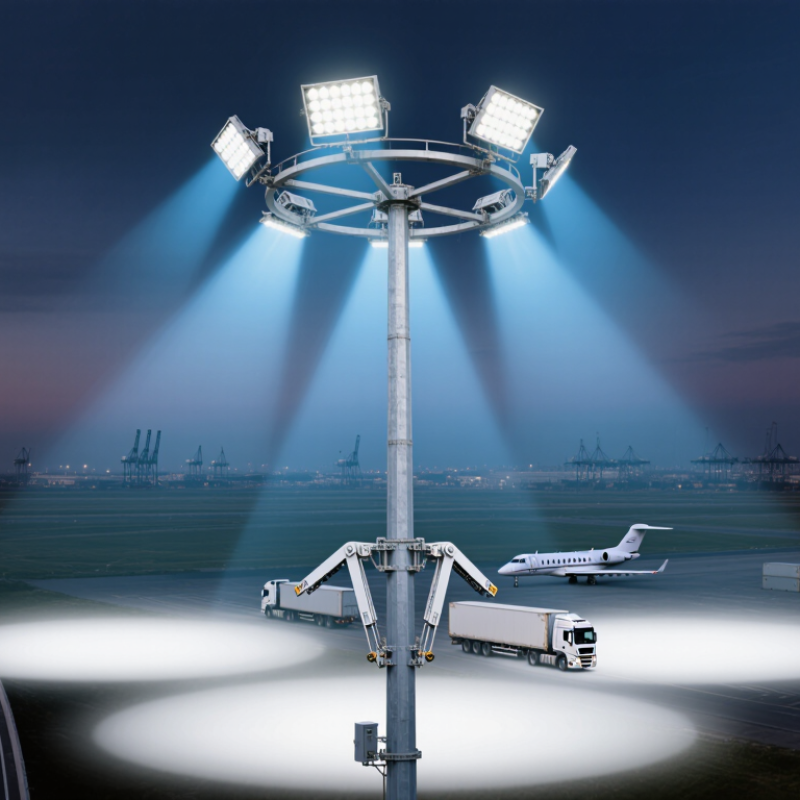
High mast lighting is a powerful outdoor illumination system designed to cover wide areas from a single, tall structure. Its poles commonly rise between 15 and 50 meters, although the height depends on site conditions and lighting requirements. At the top, several luminaires work together as a carefully aimed cluster. Their beams spread across highways, ports, airports, railway yards, parking areas, and industrial sites.

The basic principle is simple. Height creates a wider lighting pattern. Precision optics then direct light toward selected zones, reducing dark patches and unnecessary glare. Many systems use LED fixtures because they offer efficient operation, long service life, and better control than older discharge lamps. A lowering device may also bring the luminaire ring to ground level for inspection and maintenance. That detail matters. A failed fixture should not require risky climbing work.

Lighting engineer James R. Benya has described the field this way: “Lighting is both a science and an art.” His observation fits high mast design well. Engineers calculate mounting height, pole spacing, wind loads, illuminance, uniformity, and environmental impact. They must also consider how drivers, workers, and nearby residents experience the light.

No design is perfect. Glare can remain a problem when aiming is careless. Excessive brightness may create contrast instead of safety. Even a computer model cannot fully predict rain, dust, fog, or changing vehicle patterns. This guide examines how high mast systems operate, where they perform best, and why practical field experience still matters beside technical calculations.
What Is High Mast Lighting and How Does It Work?

Definition and Purpose of High Mast Lighting

High mast lighting is a large-area lighting system mounted on tall poles, commonly 60 feet or higher. The Federal Highway Administration describes these systems as poles with elevated luminaires, often using lowering devices for maintenance. Their purpose is clear: illuminate highways, ports, airports, rail yards, stadiums, and industrial yards with fewer poles and wider coverage.

In practice, high mast lighting reduces dark gaps across broad spaces. A typical installation uses several LED luminaires at the pole’s crown. Optics then direct light toward roads, loading zones, or storage areas. The U.S. Department of Energy reports that LED lighting can use at least 75% less energy and last up to 25 times longer than incandescent lighting. However, that comparison does not replace a proper project calculation. Pole height, mounting angle, weather, glare, and pavement reflectance all affect performance. A brighter system is not always a better system.

Tips: Review illuminance and uniformity values, not wattage alone. The Illuminating Engineering Society recommends evaluating average light levels alongside minimum-to-average uniformity. Ask for photometric plans before installation. Check wind loading and access requirements, too. One overlooked detail can increase maintenance costs. High mast design still involves judgment, and software cannot remove every field mistake.

Key Components of a High Mast Lighting System

A high mast lighting system begins with the mast, foundation, and lowering equipment. Typical masts rise 20 to 50 metres above large roads, ports, yards, or sports grounds. The foundation must resist wind, vibration, and uneven soil movement. A lowering ring brings luminaires down for safer inspection. This component is often ignored during early design, although maintenance access affects long-term reliability.

The luminaire contains LED modules, optical lenses, heat sinks, surge protection, and a driver. Optics shape the beam across wide areas while limiting glare and wasted light. The Illuminating Engineering Society’s RP-8-22 recommends checking maintained illuminance, uniformity, glare, and veiling luminance. The U.S. Department of Energy’s Solid-State Lighting R&D Opportunities report identifies outdoor efficacy above 100 lumens per watt as technically achievable in modern systems. However, higher efficacy does not automatically mean better visibility. Poor aiming can create dark patches. Controls may include photocells, timers, dimming modules, and remote monitoring. The electrical cabinet adds circuit protection, grounding, and emergency isolation. One weak connection can disable an entire lighting group.

Tips: Specify the target lighting level before choosing wattage. Request photometric files, wind-load calculations, and maintenance records. Check glare from driver sightlines, not only average lux. The International Energy Agency reports that lighting uses about 15% of global electricity, so controls deserve serious attention. Still, energy estimates can be optimistic. Dust, aging optics, and dirty lenses reduce real output. Schedule inspections after storms and during peak operating hours; a tidy design drawing may not reflect field conditions.

How High Mast Lighting Works

High mast lighting uses tall poles, often 12 to 40 meters high, to illuminate large outdoor areas. Typical locations include highways, ports, airports, rail yards, and sports grounds. The height spreads light across a wide zone, reducing the number of poles needed.

How High Mast Lighting Works

A high mast system places several luminaires on a crown near the pole’s top. LEDs create light, while reflectors and optical lenses direct it toward roads, storage areas, or vehicle lanes. A control panel manages switching, dimming, and sometimes scheduled operation. In many installations, technicians lower the lighting crown with a winch for inspection. This reduces the need for frequent work at extreme heights.

Good design depends on more than brightness. Engineers study pole spacing, mounting height, beam angles, glare, shadows, and local weather. Wind pressure matters. So does maintenance access. In field inspections, uneven lighting can appear beside an otherwise bright roadway. This usually points to poor aiming, aging components, or an unsuitable layout. No design is perfect; real sites often reveal assumptions that drawings missed.

Tips: Keep light directed downward and away from nearby homes or drivers. Check cables, winches, bolts, and grounding on a planned schedule. Test dimming controls after installation. Measure illumination at ground level, not only from a design screen. Wet pavement can reflect glare differently. Pay attention to that.

What Is High Mast Lighting and How Does It Work?

High mast lighting uses luminaires mounted on tall poles to illuminate large areas such as highways, intersections, ports, and sports facilities. The chart shows the theoretical relative illuminance directly below a luminaire as mounting height increases, using the inverse-square law: illuminance decreases in proportion to the square of the distance.

Relative illuminance is indexed to 100% at a 20 m mounting height and assumes the same luminous intensity, unobstructed conditions, and measurement directly below the luminaire. Actual lighting designs also depend on optics, pole spacing, tilt angle, atmospheric conditions, and surface reflectance.

Common Applications of High Mast Lighting

High mast lighting uses tall poles, usually 15 to 40 meters high, to illuminate wide outdoor areas. Powerful LED fixtures sit near the top and spread light across large distances. This arrangement reduces the number of poles needed. It can also leave roadways and work zones less crowded. The final result depends on pole height, beam angle, mounting layout, and local lighting standards.

Transport hubs are common applications. Airports, shipping terminals, and railway yards need clear visibility across runways, loading areas, and vehicle routes. High mast lights can support safer movement around containers, trucks, and service roads. They are also used on highways, interchanges, and large roundabouts. Even lighting helps drivers recognize lane changes and obstacles during dark or poor weather.

Large parking areas often use this system, especially near stadiums, shopping complexes, and public facilities. Sports fields, industrial compounds, ports, and emergency response yards may also require broad coverage. LED fixtures can provide instant illumination and lower maintenance demands when designed correctly. Yet high mast lighting is not a perfect solution. Glare may disturb nearby homes or drivers if aiming is careless. Wind loading, access for maintenance, and uneven ground require serious planning. A lighting simulation helps, but real conditions can differ. Dust, rain, and aging fixtures may reduce performance sooner than expected. Regular inspections remain necessary.

Advantages and Design Considerations for High Mast Lighting

High mast lighting uses tall poles, usually 20 to 50 metres high, to illuminate large areas with fewer luminaires. Each fixture sends a controlled beam toward roads, ports, airports, yards, or sports grounds. The raised mounting point improves coverage and keeps maintenance activity away from busy surfaces. However, height alone does not guarantee good lighting. A bright site can still feel unsafe when dark patches remain.

Its main advantage is efficient area coverage. The International Energy Agency reports that lighting uses about 15% of global electricity. The U.S. Department of Energy states that LED products can use at least 75% less energy and last up to 25 times longer than incandescent lighting. These figures are not a direct promise for every high mast project. Actual savings depend on optics, operating hours, controls, and replacement conditions. Designers should check illuminance, uniformity, glare, spill light, wind loading, foundation strength, and access for maintenance. Photometric software helps, but field verification remains important. Small errors become expensive at great height.

Tips: Select optics for the site geometry, not simply maximum brightness. Use dimming or sensors during low-traffic periods. Review wind data before fixing pole dimensions. Leave practical access for cleaning and replacement. A lower-energy design may still fail if glare disturbs drivers or nearby residents. Test one lighting zone first, then adjust beam angles after observing real shadows.

What Is High Mast Lighting and How Does It Work? - Advantages and Design Considerations for High Mast Lighting

Dimension Typical Data or Range How It Works or Why It Matters Key Design Consideration
Definition A high mast lighting system uses luminaires mounted on a tall pole, commonly about 15–50 m (49–164 ft) above ground. The elevated mounting position distributes light over a large area from a small number of locations. The pole height, luminaire optics, aiming angles, and target area must be designed as one system.
Common Applications Highways, interchanges, ports, airports, rail yards, logistics centers, large parking areas, and industrial sites. Large open spaces can be illuminated with fewer poles than conventional low-mounted systems. Check traffic, aviation, rail, maritime, and workplace lighting requirements applicable to the project.
Mounting Height Approximately 15–50 m (49–164 ft), with many roadway and area-lighting installations using 20–35 m (66–115 ft). Greater height increases coverage potential and can reduce direct glare from nearby viewpoints. Higher poles require structural analysis for wind, dynamic effects, foundation loads, access, and maintenance.
Luminaire Quantity per Pole Often 4–12 luminaires, although the actual quantity depends on pole height, optics, target illuminance, and layout. Multiple luminaires can be aimed in different directions to improve uniformity and extend coverage. Avoid excessive overlap, high glare, and unnecessary installed wattage through photometric modeling.
Light Source Modern systems generally use LED luminaires; older installations may use high-pressure sodium or metal-halide lamps. LEDs convert electrical power into light through semiconductor devices and provide controllable optical distributions. Specify lumen maintenance, surge protection, operating temperature, driver reliability, and photometric files.
Typical LED Input Power Approximately 300–1,500 W per luminaire is a common planning range for large-area applications; actual values vary widely. Power is selected to meet the required light levels, uniformity, mounting height, and optical distribution. Do not select wattage alone; compare delivered lumens, distribution, utilization, controls, and maintained performance.
Color Temperature Common choices include 3,000 K, 4,000 K, and 5,000 K, depending on visibility, environment, and policy. Color temperature affects visual appearance and may influence perceived brightness and environmental impact. Use the lowest suitable CCT where glare, wildlife, residential proximity, or skyglow is a concern.
Target Illuminance Typical maintained horizontal levels may range from about 5–50 lux, depending on road classification, activity, and safety requirements. Illuminance describes the amount of light arriving on a surface and is measured in lux. The required value must come from the applicable lighting standard or project brief rather than a generic target.
Uniformity Design goals commonly specify an average-to-minimum or maximum-to-minimum ratio; the accepted ratio depends on the application. Uniform light reduces dark patches, improves visual comfort, and supports safer movement. Evaluate the complete calculation grid, including boundaries, road surfaces, ramps, and conflict areas.
Pole Spacing Spacing is project-specific; a preliminary layout may begin around 3–5 times pole height, subject to photometric verification. Spacing influences overlap, uniformity, installed quantity, cabling, and energy use. Use photometric software and include obstruction, terrain, road geometry, and property-boundary constraints.
Optical Distribution Narrow, medium, wide, asymmetric, and roadway distributions are selected according to the area geometry. The optic shapes the beam, directs light to the task area, and limits wasted spill light. Select optics based on mounting height, aiming limits, pole location, and required spill-light control.
Glare and Spill Light Potential sources include high-intensity beams, poorly aimed luminaires, excessive tilt, and light outside the project boundary. Shielding, precise optics, appropriate aiming, and dimming can reduce unwanted brightness and visual discomfort. Assess adjacent homes, roads, waterways, wildlife habitat, airports, and observatories where relevant.
Energy Performance LED systems can reduce energy consumption compared with older discharge-lamp systems, especially when dimming and scheduling are used. Efficient sources, accurate optics, adaptive controls, and lower maintenance requirements improve lifecycle performance. Compare annual kWh, operating hours, control profiles, maintenance, replacement, and disposal costs.
Maintenance Access Systems may use lowering devices, winches, hinged platforms, or specialized access equipment. The luminaire assembly is brought to a safer working position or reached with suitable maintenance equipment. Provide safe access, fall protection, isolation procedures, replacement parts, and adequate service clearances.
Structural and Wind Design Design must account for pole height, luminaire weight, projected area, wind speed, exposure, soil, and local code requirements. Wind loads create bending and overturning forces that are transferred through the pole and foundation. A qualified structural engineer should verify pole capacity, anchor bolts, fatigue, foundation, and corrosion protection.
Controls and Monitoring Options include photocells, astronomical timers, motion sensors, scheduled dimming, remote monitoring, and fault alerts. Controls adjust operating time or output to match traffic, occupancy, daylight, and security needs. Confirm control compatibility, fail-safe behavior, cybersecurity requirements, communications coverage, and commissioning procedures.
Primary Advantages Large-area coverage, fewer poles, reduced obstruction at ground level, improved maintenance planning, and potential energy savings. High mounting and coordinated optics can provide broad, consistent illumination while keeping equipment away from busy ground areas. Benefits are realized only when the system meets lighting, structural, electrical, environmental, and maintenance requirements.

Note: Values shown are general planning ranges. Final performance requirements should be confirmed through a site-specific photometric calculation and the applicable local standards.

Article Source:

"*" indicates required fields