How to Choose a Copper Stamping Machine?

Choosing a Copper Stamping Machine is not simply a matter of selecting the largest press. It requires evidence, process experience, and careful cost judgment. Grand View Research valued the global metal stamping market at approximately USD 283 billion in 2023. Its forecast also indicates steady growth through 2030. Meanwhile, the U.S. Geological Survey continues to identify copper as a critical material for electrical equipment, construction, and transportation. These trends increase pressure for accurate, repeatable copper forming.

Richard Crowson, author of Handbook of Metal Stamping, offers a useful principle: “The best press is the one that produces the required part consistently, not merely the one with the highest tonnage.” This advice matters when comparing mechanical, servo, and hydraulic systems. A practical evaluation should examine material thickness, copper alloy, strip width, required stroke rate, die size, feeder accuracy, and allowable burr height. Ask for documented tests using your actual copper grade.

Look closely at the details. Does the machine control springback? Can it maintain alignment after hours of production? Is spare-part support available locally? These questions often matter more than brochure speed. A 160-ton press may outperform a 250-ton model when its servo feed reduces scrap and protects delicate contacts.

No single machine wins every job. That is the difficult part. Energy reports, supplier claims, and factory trials can disagree. Buyers should therefore request sample parts, maintenance records, noise data, and total operating costs. A modest machine with disciplined setup may deliver better results than an impressive machine chosen too quickly.
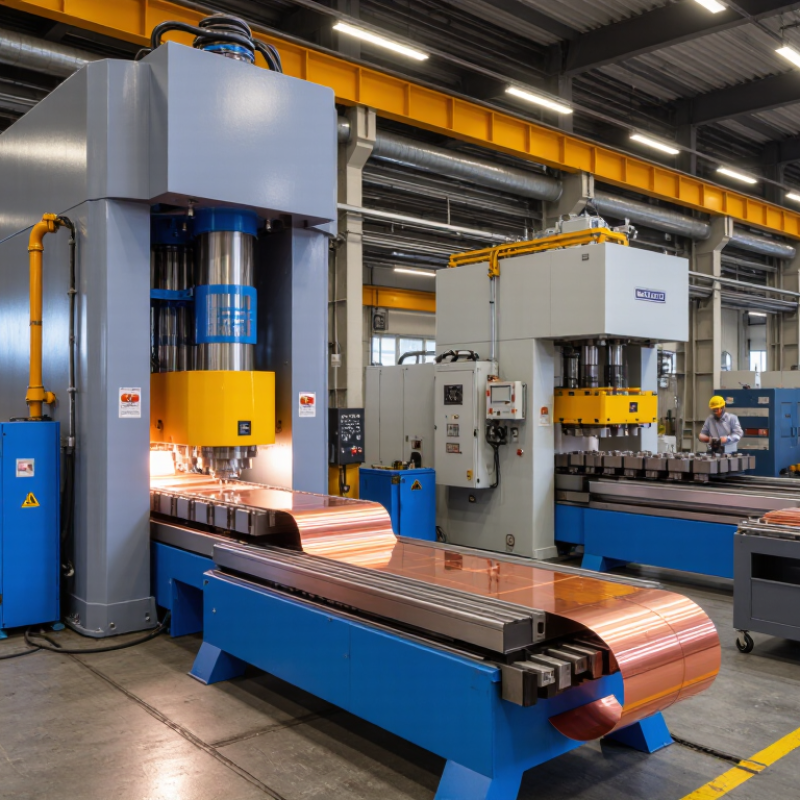
How to Choose a Copper Stamping Machine?

Understanding Copper Stamping Machines and Their Main Functions

How to Choose a Copper Stamping Machine?

Understanding Copper Stamping Machines and Their Main Functions

A copper stamping machine converts flat copper strip into precise parts through controlled pressure. Its main functions include feeding, positioning, punching, bending, and forming. A press applies force through a die, while sensors monitor strip movement and tool position. Copper conducts heat and electricity well, but it can scratch, buckle, or work-harden during production. A practical trial should inspect sample parts under magnification. Tiny burrs often reveal problems before production numbers do.

Choosing capacity requires more than reading the rated tonnage. Match the machine to copper thickness, part geometry, stroke length, and required output. A servo or mechanical press may suit different production rhythms. The feeder must hold the strip firmly without marking its surface. Ask for data on repeatability, die compatibility, guarding, noise, and maintenance access. Operators should reach adjustment points safely, with clear controls and documented procedures. Small details matter.

In my experience, the best assessment uses actual copper material, not a generic steel sample. Run several cycles, then measure hole diameter, bend angle, flatness, and burr height. Check the scrap rate after the machine warms up. That is where surprises appear. I would question optimistic speed claims because they may exclude setup time and tool changes. No machine is perfect. A careful buyer leaves room for calibration, training, and process corrections.

Identifying Production Requirements and Suitable Machine Types

Choosing a copper stamping machine starts with the part, not the machine catalog. Start with the part. Record copper grade, thickness, strip width, blank size, and tolerance. Then estimate hourly output, shift patterns, and expected tool life. These figures reveal the real production load. A prototype may need 20 strokes per minute, while high-volume production may require several hundred. Do not trust nominal tonnage alone. Calculate forming force, stripping force, and a safety margin with a qualified tool engineer. Copper conducts heat well, but thin strip can buckle during feeding. That detail is easy to miss.

For flat terminals, washers, and simple brackets, a mechanical press with a compound die may provide accurate, economical cycles. Progressive dies suit long runs with several operations, including piercing, bending, and cut-off. Deep or irregular shapes may require a servo press or hydraulic press. Consider speed, force control, and draw depth. Servo control can reduce material stress, but it may increase programming work and cost. Hydraulic systems offer flexible force profiles, although cycle speed can be lower. Match the machine to the die, feeder, and inspection method as one system.

Before purchasing, run representative copper strip through a production-style die. Test it under load. Check burr height, edge cracks, flatness, feed accuracy, noise, and temperature after a full shift. Ask whether the frame maintains alignment under repeated loads. I have seen machines pass a short trial and struggle after hours of cycling. That experience changed how I judge capacity. A perfect specification sheet is not enough. Confirm spare parts, operator training, lubrication access, and measurement records. If demand is uncertain, leave room for a second feeder or future tooling. Do not guess.

How to Choose a Copper Stamping Machine? — Identifying Production Requirements and Suitable Machine Types

Production Requirement Typical Copper Part or Operation Suitable Machine Type Typical Capacity Range Recommended Operating Characteristics Key Selection Considerations
Low-volume / prototype Simple brackets, washers, terminals, experimental parts, and short production runs Mechanical gap-frame press Approximately 10–80 metric tons Moderate stroke rate; manual, hand-fed, or simple batch operation Choose adjustable stroke and shut height, accessible tooling space, and suitable guarding. A smaller press reduces initial investment and is easier to set up for frequent die changes.
High-volume blanking Flat discs, plates, electrical contacts, and repetitive outline shapes from copper strip or sheet High-speed mechanical press Approximately 30–160 metric tons Typically 200–1,000 strokes per minute, depending on part size, material thickness, and die design Prioritize rigid construction, low vibration, accurate ram guidance, reliable lubrication, and a compatible automatic strip feeder.
Progressive stamping Small terminals, connectors, clips, lead frames, and multi-step electrical components Straight-side mechanical press with progressive-die feeding Approximately 40–250 metric tons High repeatability, stable feed pitch, and continuous coil processing Verify die width, feed-line height, slide length, shut height, press speed, and the required number of die stations. Adequate tonnage must be available at the actual forming position, not only at the bottom of the stroke.
Precision forming Deep-drawn cups, formed covers, embossed parts, and components requiring controlled material flow Servo mechanical press Approximately 50–300 metric tons Programmable slide motion, controlled dwell, and adjustable speed through the forming zone Servo motion can improve forming control and reduce sliding damage, but the die, lubrication, blank-holder system, and copper temper must also be matched to the operation.
Heavy forming Thicker copper busbars, large connectors, substantial bends, and low-to-medium production volumes Hydraulic press Approximately 100–1,000+ metric tons Slower cycle rate with adjustable force, pressure, and dwell time Hydraulic presses are suitable when force must be maintained over part of the stroke or when complex forming requires controlled motion. Consider energy use, cycle time, oil temperature control, and maintenance requirements.
Thin strip stamping Thin copper contacts, springs, shielding pieces, and miniature electronic components High-speed precision press Approximately 10–80 metric tons High speed with precise feed control; commonly used with narrow coil stock Focus on press stability, die clearance, feed accuracy, strip straightening, and scrap removal. Excessive speed or incorrect clearance can increase burrs and material distortion.
Thick sheet / busbar Electrical busbars, grounding components, switchgear parts, and large conductive plates Straight-side mechanical or hydraulic press Approximately 160–800 metric tons Lower speed, high frame rigidity, and sufficient daylight for the tooling Calculate cutting and forming loads separately. Confirm bed dimensions, point-of-load capacity, die support, maximum material thickness, and safe handling of large blanks.
Variable product mix Different copper alloys, thicknesses, part sizes, and frequent tooling changes Servo press or programmable hydraulic press Selected according to the highest required forming load Adjustable speed, stroke profile, and programmable production settings Useful when one machine must handle several products. Confirm that the control system can store recipes and that the available die space supports all planned tools.
Automated production cell Continuous coil-to-part production with in-die sensing, inspection, and automatic collection Automated mechanical or servo press line Approximately 50–400 metric tons for many precision strip applications Coil feeder, straightener, sensors, die protection, scrap handling, and part collection integrated with the press Evaluate the complete line rather than the press alone. Synchronization, sensor response, emergency stopping, access protection, and changeover time directly affect overall equipment effectiveness.

Note: Capacity and speed ranges are typical engineering guidelines, not universal limits. Final selection should be based on copper alloy, temper, thickness, blank size, die design, required production rate, calculated forming load, and applicable safety standards.

Comparing Machine Capacity, Accuracy, Speed, and Automation

How to Choose a Copper Stamping Machine?

Capacity should match the copper strip, part geometry, and die load. Oversizing wastes energy and floor space. Undersizing causes deflection, burrs, and unstable dimensions. Calculate tonnage from material thickness, perimeter, shear strength, and a safety margin. Also check bed size, shut height, stroke length, and allowable die weight. These details matter more than a large headline capacity.

Accuracy Accuracy is not only a machine specification. Frame rigidity, slide guidance, lubrication, and feeder repeatability affect every terminal or connector. For tight copper parts, inspect dimensional drift during a long production run, not only during setup. ISO 230 measurement principles can support repeatable machine testing, although they do not replace practical die trials. A 0.01-millimeter claim may sound impressive. It still needs verification under real load.

Speed

Speed should be judged against quality and uptime. A faster stroke rate is useless if copper strips buckle or tools require frequent adjustment. The International Federation of Robotics reported 541,302 industrial robot installations worldwide in 2023, showing how quickly automation is expanding. Consider servo feeders, automatic coil loading, vision inspection, die protection, and production data collection. Automation reduces handling errors, but it can also create expensive mistakes when sensors are poorly configured. Run sample coils, measure scrap, and compare actual cycle stability. My experience suggests that a slightly slower machine often performs better when setup changes are frequent.

Evaluating Tooling, Material Compatibility, Safety, and Maintenance

Choosing a copper stamping machine starts with the tooling, not the advertised tonnage. Copper is soft, conductive, and prone to galling when clearances or lubrication are poorly controlled. Tool steel selection, die alignment, and punch-to-die clearance should match the copper grade and sheet thickness. The International Copper Study Group reported global refined copper usage above 26 million tonnes in 2024, showing the scale of demand for consistent forming quality. Yet production volume alone should not decide the machine.

Material compatibility needs practical testing. Check feed accuracy, coil tension, surface protection, and heat buildup during continuous runs. Copper’s high conductivity can expose weaknesses in sensors, electrical connections, and control cabinets. ISO 12100 recommends documented risk assessment, while OSHA 1910.212 emphasizes guarding at points of operation. Maintenance should include daily die inspection, weekly lubrication checks, and scheduled verification of force, alignment, and emergency stops. I have seen clean-looking tooling produce burrs after only a few hours. That detail is easy to miss.

Tips: Request trial stamping with your actual copper grade. Measure burr height, springback, dimensional drift, and die temperature. Keep a maintenance log with photos. Replace damaged guards immediately. Do not trust a perfect first sample; copper behavior can change with batch, temper, and tooling wear. A spreadsheet cannot predict every coil variation. Reconsider the setup when scrap rises, even if the machine still runs. Reports from the U.S. Bureau of Labor Statistics continue to identify manufacturing as a high-risk environment, so safe access and isolation procedures deserve equal weight with output.

How to Choose a Copper Stamping Machine? Electrical conductivity is a useful material-compatibility indicator when selecting tooling clearance, forming force, cooling, and inspection requirements. These typical room-temperature values are expressed as a percentage of the International Annealed Copper Standard (% IACS); actual performance varies with temper, thickness, and supplier specifications.

Selecting a Machine Based on Cost, Efficiency, and Long-Term Value

How to Choose a Copper Stamping Machine?

Copper demand is becoming less forgiving. The International Energy Agency’s Global Critical Minerals Outlook 2024 projects copper demand rising from about 26 million tonnes in 2023 to 31 million tonnes by 2035. That growth supports added capacity, but it does not justify buying the largest press.

Compare the full cost: machine price, tooling, feeder installation, electricity, maintenance, scrap, and downtime. Request a written quote. Measure twice. Buy once.

Efficiency must be measured with your actual copper strip, thickness, and part geometry. The U.S. Department of Energy reports that motor-driven systems consume more than half of industrial electricity.

Ask for energy data at your required stroke rate, not only an impressive maximum speed. Check parts per minute, changeover time, misfeeds, and usable production hours.

A practical trial using real material is more reliable than a brochure.

Small losses accumulate quickly.

Long-term value depends on serviceability. Examine frame stiffness, guides, crankshaft access, control-system support, and spare-part lead times. A lower-priced machine may become expensive after repeated stoppages.

However, a premium specification can also remain underused. That is an easy mistake to make.

Use a five-year cost model, including expected scrap and maintenance. The IEA forecast is useful context, not a production schedule.

Sometimes, the cheaper press wins.

"*" indicates required fields