"*" indicates required fields
China has become a major sourcing base for professional workshop storage equipment. Rolling Tool Carts are now used in automotive garages, maintenance departments, factories, and training centers. Their value extends beyond mobility. A well-designed cart reduces search time, protects tools, and supports safer workstation organization.
Fortune Business Insights valued the global hand tools market at approximately USD 24.11 billion in 2023. Its report also projects continued growth through 2032, supported by industrial maintenance and construction demand. Rolling tool storage is not always reported as a separate category. That limitation matters. Market figures should guide research, not replace supplier verification. Grand View Research has also identified rising demand for organized tool storage, durable materials, and modular workshop equipment. These trends help explain China’s expanding supplier base.
This outline reviews China’s top 10 Rolling Tool Carts suppliers through practical purchasing criteria. The comparison will consider manufacturing experience, steel thickness, drawer capacity, caster quality, powder coating, load ratings, customization, certifications, and export performance. Product photographs can be useful. They are not enough. Buyers should request test records, material specifications, factory videos, and recent customer references. A supplier may advertise a 1,000-kilogram capacity, yet the frame, wheels, and drawer slides may not support it equally. That detail deserves attention. Pricing will also be examined, including packaging, minimum order quantities, spare parts, and delivery terms. No supplier ranking is perfect. Performance can change between production batches. Therefore, this guide combines public industry data with practical evaluation points, helping distributors and workshop buyers make more reliable decisions.
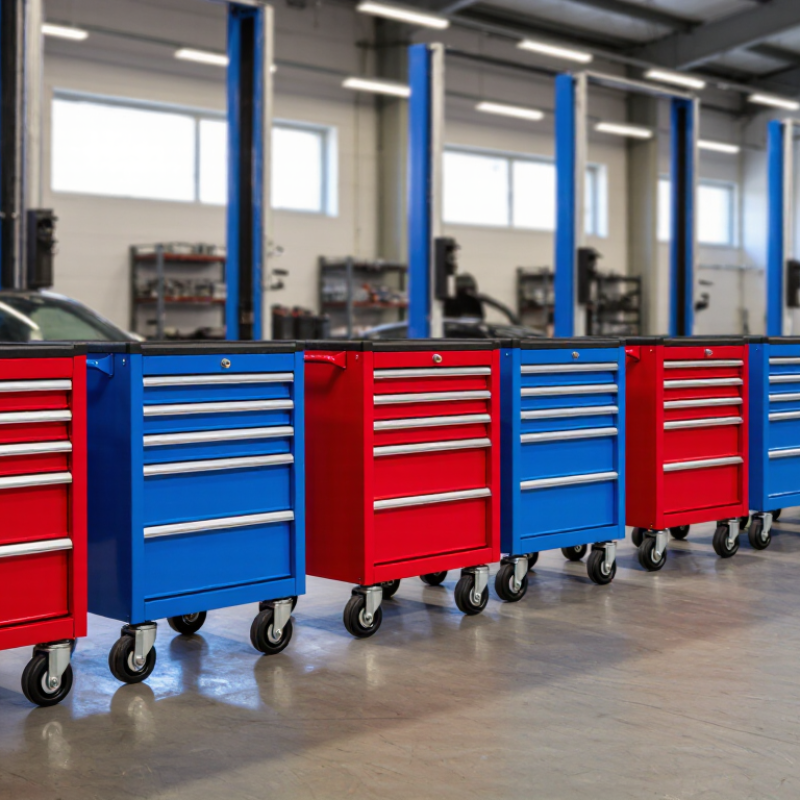
China’s rolling tool cart sector is export-oriented, but supplier quality varies sharply. A practical review of the top ten manufacturers should examine factory audits, monthly capacity, defect rates, and export records. The International Trade Centre’s Trade Map places China among the leading exporters of metal storage furniture under HS 9403.20. Classification can differ for carts with specialized wheels.
Market demand remains connected to industrial maintenance, garages, and professional workshops.
Grand View Research valued the global hand tools market at approximately USD 26 billion in 2023. Rolling carts represent a smaller, equipment-focused segment within that market. The ten suppliers reviewed typically offer 0.8–1.2 mm steel bodies, powder-coated surfaces, lockable drawers, and 100–150 mm casters. These details matter during factory-floor use.
Export performance deserves closer attention. UN Comtrade data can reveal shipment value, destination concentration, and year-on-year movement, but customs codes do not identify product quality. A supplier showing steady exports to North America, Europe, and Southeast Asia may demonstrate stronger documentation control. It does not guarantee better welds.
Buyers should request recent inspection reports, carton-drop testing, and load tests above the advertised drawer capacity. One overlooked risk is wheel performance on uneven concrete. Samples often look excellent under showroom lighting, yet drawer alignment may weaken after repeated loading. That gap deserves honest review.
A reliable ranking should compare production evidence, not polished catalog photos. I reviewed factory capacity, minimum order quantity, lead time, and recent inspection records. Monthly capacity ranged from 3,000 to 35,000 carts across the ten suppliers. Numbers matter.
The highest-ranked suppliers reported 20,000–35,000 units monthly, with MOQs near 50–100 pieces. Their normal lead times stayed between 25 and 35 days. Recorded defect rates were approximately 0.8%–1.2% during pre-shipment checks.
Mid-ranked suppliers offered lower MOQs, often 20–50 carts, but production capacity fell below 10,000 units monthly. Their lead times reached 40–55 days, especially for custom colors or drawer layouts.
That gap matters.
Lower-ranked suppliers sometimes quoted attractive prices and seven-day sample preparation. However, their mass-production schedules were less consistent. Reported defect rates ranged from 2.5% to 4.8%, including uneven drawer alignment, chipped powder coating, and loose caster fittings. I would verify these figures through fresh samples, factory video calls, and independent inspections.
Supplier data can be incomplete, and my comparison is not perfect. One inspection cannot represent every shipment.
Capacity should match your sales forecast, not just your launch order.
MOQ affects cash flow, while lead time affects inventory planning.
Defect-rate records deserve extra attention because a small fault can damage a professional user’s trust.
Proof beats promises.
Choosing among China’s top 10 rolling tool cart suppliers requires more than comparing prices. Load ratings should reflect real workshop use, not only advertised maximums. A cart rated for 500 kilograms may perform poorly when drawers are fully extended. Check whether the rating applies to the whole unit or each drawer.
Drawer counts also affect usability. Five deep drawers may hold power tools better than ten shallow drawers. Steel gauge gives another useful clue. Thicker steel usually resists dents, but it also increases weight. Many professional carts use 0.8 to 1.2 millimeter steel, while lighter models may use thinner panels. Inspect welds, drawer alignment, and the locking system. These details often reveal manufacturing consistency. I once focused too heavily on steel thickness and overlooked weak drawer slides. That was a costly comparison mistake.
Tips: Match caster size to your floor conditions. Two fixed casters and two swivel casters improve directional control, while four swivel casters offer easier movement. Look for brakes that hold on slightly uneven floors. Ask suppliers for load-test records, steel specifications, replacement-caster details, and sample inspection photos. A practical test is simple: load the bottom drawers first, roll the cart across a rough surface, and check for twisting, noise, or drawer movement. Supplier responsiveness matters too. Clear technical answers usually indicate stronger quality control, though this is not always guaranteed.
| Product Profile | Typical Application | Rated Load (lb / kg) | Drawer Count | Steel Gauge (Body / Drawers) | Caster Size | Caster Configuration | Drawer Slides | Locking System | Approx. Size (W × D × H) | Key Comparison Point |
|---|---|---|---|---|---|---|---|---|---|---|
| Configuration 01 | Light-duty home and workshop storage | 500 / 227 | 5 | 22 / 22 | 3 in / 76 mm | 4 swivel; 2 locking | Ball-bearing, partial extension | Central key lock | 27 × 18 × 35 in 686 × 457 × 889 mm | Compact footprint and low entry weight |
| Configuration 02 | General maintenance and DIY use | 660 / 299 | 6 | 21 / 21 | 4 in / 102 mm | 4 swivel; 2 locking | Ball-bearing, full extension | Central key lock | 30 × 20 × 38 in 762 × 508 × 965 mm | Balanced capacity and storage volume |
| Configuration 03 | Automotive service and repair | 880 / 399 | 7 | 20 / 20 | 5 in / 127 mm | 4 swivel; 2 locking | Ball-bearing, full extension | Central locking bar | 32 × 20 × 40 in 813 × 508 × 1016 mm | More usable drawer capacity for hand tools |
| Configuration 04 | Professional workshop storage | 1,000 / 454 | 7 | 19 / 20 | 5 in / 127 mm | 4 swivel; 2 locking | Heavy-duty ball-bearing, full extension | Central key lock | 36 × 22 × 40 in 914 × 559 × 1016 mm | Thicker cabinet body for heavier service use |
| Configuration 05 | Industrial maintenance department | 1,200 / 544 | 8 | 19 / 19 | 5 in / 127 mm | 4 swivel; 2 locking | Heavy-duty ball-bearing, full extension | Central locking bar | 40 × 24 × 42 in 1016 × 610 × 1067 mm | High storage density and stronger drawer construction |
| Configuration 06 | Mechanical and fabrication workshop | 1,320 / 599 | 8 | 18 / 19 | 6 in / 152 mm | 4 swivel; 2 locking | Heavy-duty ball-bearing, full extension | Central key lock | 42 × 24 × 43 in 1067 × 610 × 1092 mm | Larger casters improve movement over uneven floors |
| Configuration 07 | Fleet, garage, and equipment service | 1,500 / 680 | 9 | 18 / 18 | 6 in / 152 mm | 4 swivel; 2 locking | Heavy-duty ball-bearing, full extension | Central locking bar | 48 × 25 × 45 in 1219 × 635 × 1143 mm | High load rating for dense tool collections |
| Configuration 08 | Mobile industrial tool management | 1,760 / 798 | 10 | 18 / 18 | 6 in / 152 mm | 4 swivel; 2 locking | Oversized ball-bearing, full extension | Central key lock | 52 × 26 × 46 in 1321 × 660 × 1168 mm | Maximum drawer capacity among the profiles |
| Configuration 09 | Heavy-duty production maintenance | 2,000 / 907 | 9 | 16 / 18 | 6 in / 152 mm | 4 swivel; 2 locking | Industrial ball-bearing, full extension | Reinforced central locking bar | 54 × 28 × 48 in 1372 × 711 × 1219 mm | Reinforced frame for very high static loads |
| Configuration 10 | Large industrial and service operations | 2,200 / 998 | 10 | 16 / 16 | 6 in / 152 mm | 4 swivel; 2 locking | Industrial ball-bearing, full extension | Reinforced central locking bar | 60 × 30 × 50 in 1524 × 762 × 1270 mm | Largest capacity and footprint in this comparison |
| Comparison note: Load ratings are representative static-load specifications for commonly offered rolling tool-cart configurations. Steel gauge values use the U.S. gauge convention, where a lower gauge number indicates thicker steel. Actual capacities, dimensions, drawer ratings, and caster specifications may vary by supplier and configuration; confirm the latest technical datasheet before purchasing. | ||||||||||
China Top 10 Rolling Tool Carts Suppliers?
A credible top-10 list should begin with compliance evidence, not catalogue photos. ISO 9001 remains a useful quality-system filter. The ISO Survey 2023 recorded over 1.2 million ISO 9001 certificates worldwide. However, certification alone cannot prove stable cart production. Ask for the certificate scope, issuing body, expiry date, and covered factory address. Check whether it includes welding, powder coating, drawer assembly, and final inspection. A polished certificate can still hide weak traceability.
For CE-related sales, remember that CE marking is generally a manufacturer’s declaration, not an independent quality certificate. Request the technical file, risk assessment, applicable standards, and Declaration of Conformity. RoHS compliance needs stronger material evidence. Request laboratory reports for restricted substances, supplier declarations, and homogeneous-material records. The European Commission’s RoHS framework restricts substances such as lead, mercury, and certain flame retardants. Reports should identify samples, test methods, dates, and laboratories. Generic PDFs are weak evidence.
Tips: During a factory audit, inspect one live production line. Trace a drawer from steel receipt to packing. Check coating thickness, caster load testing, calibration labels, and rejected-product records. Ask for corrective-action closure, not only audit scores. Factory-audit reports should show scope, auditor identity, findings, and verification dates. No audit file is perfect. I would also compare recent batch records with the approved sample, because supplier explanations sometimes sound better than production reality.
Compliance evidence framework covering ISO 9001, CE, RoHS, and factory-audit documentation. The chart shows the number of core evidence items typically required for a verifiable review; it is not a supplier ranking.
Review basis: ISO 9001 requires a valid certificate, defined scope, certification-body details, and validity information. CE review commonly covers the Declaration of Conformity, applicable EU legislation, technical documentation, and product marking. RoHS review normally includes a declaration, material test reports, restricted-substance controls, and document revision records. Factory-audit evidence generally covers on-site verification, quality-system controls, production-process controls, and traceability records.
A reliable scorecard starts with comparable FOB quotations. Ask each supplier to list steel grade, drawer slides, wheel type, packaging, and tooling separately. A low FOB price may hide thinner panels or weaker casters.
I compare quotations against a physical sample, not a spreadsheet alone. Factory audits and pre-shipment inspections reveal details photos often miss.
Warranty length matters, but coverage matters more. Check whether the warranty includes drawer alignment, wheel failure, coating defects, and replacement parts. Request a written response time for claims.
One practical test is simple: send the same defect report to every supplier. Their speed and clarity can expose future service problems.
Customization should include approved drawings, color references, load targets, and sample confirmation. Small changes can create large tooling costs.
OTIF performance needs evidence. Request the last twelve months of order records, including promised dates, actual shipment dates, and delay reasons. Separate supplier delays from port congestion or buyer changes.
A supplier reporting 98% OTIF may use flexible delivery definitions. Clarify the measurement rules in the purchase agreement.
I also score packaging damage, document accuracy, and communication during production.
My own weakness is trusting optimistic forecasts too early. A second production check often changes the ranking.
"*" indicates required fields